What a trailing drawdown is
Every prop firm account has a line it must not cross. On a trailing drawdown that line follows your balance up. Start a $50,000 account with a $2,000 trailing drawdown and the floor is $48,000. Make $500 and it moves to $48,500. Lose that $500 again and the floor stays at $48,500.
So your room, the distance between balance and floor, can only shrink when you lose, and it never grows past the starting drawdown while the floor is still trailing. That is the part most new evaluation traders miss.
Intraday vs end-of-day trailing drawdown
Both kinds work the same way: the floor sits a fixed distance below the highest point the account has reached. The difference is what counts as the highest point, and when the firm looks for it.
Intraday trailing
The firm watches your balance tick by tick through the session, open trades included. Whenever the account reaches a new high, even on profit you have not taken, the floor moves up straight away. If the trade then comes back, the floor stays where it was. Your room at any moment is the drawdown minus how far you are below the account’s highest point, open profit included.
End-of-day trailing
The floor is worked out once a day, after the session closes, from your closing balance. If that close is a new best, the floor moves up; if not, it stays. Open profit during the day never moves the floor, however high it runs. At the start of each day your room is the drawdown minus how far today’s balance is below your best close.
| Intraday trailing | End-of-day trailing | |
|---|---|---|
| When the floor moves | Any time during the session | Once a day, after the close |
| What sets it | Your highest balance, open profit included | Your highest closing balance |
| Open profit you give back | Costs you room | Costs nothing, unless the close is lower |
| Open losses during the day | Count straight away | Usually count straight away too (see below) |
| What to watch | How much open profit you let a trade give back | Where you close each day |
A third kind, a static drawdown, never moves: the floor is fixed when the account starts. The account’s name rarely tells you which one you have. Look for words like “intraday”, “real-time”, “end of day” or “EOD” on the rules page for your exact account size and type, and read it before the first trade.
Why a winning trade can leave you closer to failing
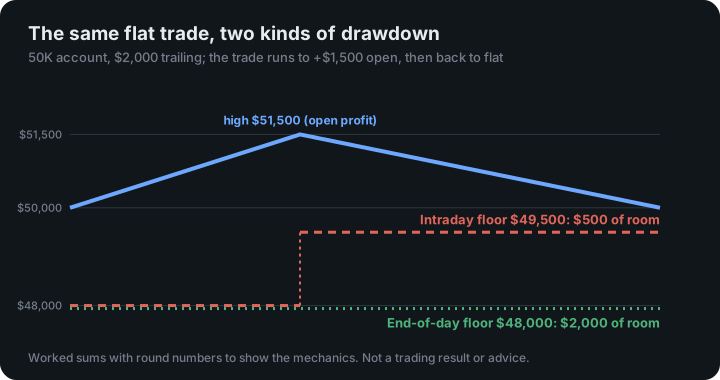
Take the same $50,000 account, $2,000 drawdown, floor at $48,000. You buy, and the trade runs to $1,500 of open profit. Then it comes all the way back and you close it flat. Your balance is $50,000, exactly where you started. Here is what each kind of drawdown does with that:
| Intraday trailing | End-of-day trailing | |
|---|---|---|
| Highest balance seen | $51,500 (open profit) | $50,000 (the close) |
| Floor after the trade | $49,500 | $48,000 |
| Room left | $500 | $2,000 |
Worked sums with round numbers to show the mechanics. Not a trading result or advice.
On the intraday account, a trade that made nothing used up three-quarters of the room. The floor followed the open profit up and stayed there. Taking profit earlier, or not letting a winner run all the way back, matters far more on an intraday account than on an end-of-day one.
Now a winning day. The same trade runs to $1,500 of open profit and you close it up $800, so the balance is $50,800. Intraday, the floor is still $49,500 from the open peak, leaving $1,300 of room: the $700 you gave back came out of it. End of day, $50,800 is a new best close, so the floor moves to $48,800 after the close and you start tomorrow with the full $2,000. In short, intraday charges you for every dollar given back from the peak; end of day charges you only when a close comes in below your best close.
End of day does not mean safe until the close
An end-of-day drawdown moves once a day, but that is not the same as being checked once a day. Topstep is a clear example. Its help centre says the Maximum Loss Limit “updates at the end of each trading day but is monitored in real time throughout the session,” and that realized and unrealized P&L both count toward it.
Topstep’s own example on a 50K Trading Combine: the floor starts at $48,000. Close day one up $500 and it rises to $48,500. Give back $500 on day two and the balance is $50,000 again, but the floor stays at $48,500. You now have $1,500 of room, not $2,000.
LucidFlex uses the same end-of-day idea with a fixed stopping point. Lucid’s help centre says the Max Loss Limit is recalculated at the end of each session from your highest closing balance. Once the balance passes the Initial Trail Balance, the floor locks and stops moving. On a 50K account that means a $2,000 limit that locks at $50,100 once the balance has passed $52,100.
The stakes differ by account. Topstep says a breach in the Trading Combine liquidates the account for the rest of the day and makes it ineligible for funding until you reset; in an Express Funded Account the account is closed.
When the floor stops trailing
Many firms stop trailing at some point, after which the floor is fixed. At Topstep the Maximum Loss Limit locks at the starting balance. On the 50K Trading Combine, with its $2,000 limit, that happens once your closing balance reaches $52,000: from then on the floor stays at $50,000. Topstep lists the limit as $2,000 on the 50K, $3,000 on the 100K and $4,500 on the 150K.
Firms lock at different levels, and some intraday accounts keep trailing. Find the lock level for your account and write it down: until you reach it, every new high raises the floor.
Your real room today
room = current balance (open trades included) − floor
If the account also has a daily loss limit, compare the two and plan around the smaller. A $1,000 daily limit means nothing when you are $600 above the floor. The LucidFlex daily loss limit guide works through sizing trades from that number.
Before every session
- Know which kind of drawdown your account has, and where it locks.
- Write down today’s floor and your room to it.
- On an intraday account, decide in advance how much open profit you will give back.
- Size each trade so a full loss leaves room for the rest of your plan.
Tracking it in Crux
Crux is a trading journal. It reads your fills; it never places a trade. Here is what it does with an evaluation account:
- Evaluation tracks the account against its rules, with intraday trailing, end-of-day trailing and static drawdowns. Start from a preset or choose Custom, then check every number against your account. How evaluations work.
- Alerts email you when half your drawdown cushion is used. They come from closed trades, so Crux cannot see an open position’s peak; your firm’s dashboard is the live number.
- Before you trade takes the tightest room you have, across your own daily limit and every evaluation, and divides it by what one contract loses at your stop. How it works.
Evaluations and alerts are on the Elite plan and in every free trial. To check an account without connecting anything, the free prop firm calculator works out your floor and room from numbers you type in.
Questions
What is a trailing drawdown?
A floor under your account balance that moves up as the balance makes new highs and never moves down. If the balance touches the floor, the account fails. The distance between the two is how much you can lose before that happens.
What is the difference between intraday and end-of-day trailing drawdown?
An intraday trailing drawdown follows your highest balance during the day, including open profit you have not taken, so profit you give back costs you room. An end-of-day trailing drawdown moves only once a day, from your closing balance, so open profit during the day never moves it. A trade that runs to $1,500 and closes flat leaves $500 of a $2,000 drawdown intraday, and all $2,000 end of day.
Do open losses count against an end-of-day trailing drawdown?
At Topstep, yes. Its help centre says the Maximum Loss Limit updates at the end of each day but is monitored in real time, and that realized and unrealized P&L both count. End of day describes when the floor moves, not when it is enforced.
Does the trailing drawdown ever stop moving?
At Topstep it locks at the starting balance: on a 50K Trading Combine with a $2,000 limit, once your closing balance reaches $52,000 the floor stays at $50,000. Other firms lock at different levels or not at all, so check your own firm's rules.
How do I work out how much room I have left?
Subtract the floor from your current balance, open trades included. Then compare that with any daily loss limit and plan around the smaller of the two.
Source: Topstep: What is the Maximum Loss Limit?, Lucid Trading: LucidFlex Drawdown, read on 19 October 2026. Topstep is a trademark of its owner; Crux is not affiliated with Topstep. Seen something out of date? Email support@cruxjournal.com and we will fix it.